Showing posts with label Short Tailed Weasels. Show all posts

Wednesday, April 25, 2018

Short-tailed Weasels Weather the Storm at Lookout Mountain


The Short-tailed Weasels met at Lookout Mountain Forest Preserve for a day of exploration and working on carving skills. They circled up in the parking lot as the rain poured down and saturating everything, including our rain layers. After revisiting our three group commitments we made a plan for the day: hike to the waterfall and spend some time exploring for amphibians, then connect with the main logging road to harvest some of the Vine Maple from the brush cutting that had been done to maintain the width of the road. We would be able to make some excellent tend pegs and digging sticks from the strong and dense Vine Maple hardwood.
Looking around the circle the boys were clearly ready to retreat under the shelter of the forest canopy. Hiking along the signs of spring were all around, a full spectrum of the color green engulfed the forest. Salmonberry flowers were in peak bloom and the Cottonwood leaves were beginning to sprout, sending their sweet aroma into the air. As a mentoring strategy we try to highlight these seasonal changes for the boys so they can begin to recognize the signs of changing seasons. Drawing connections to exploring in the pouring rain and its ability to transform the forest has proven to lighten the Explorers hearts in the toughest of conditions. Two Explorer Club mottos come to mind in these moments attitude of gratitude and all things are connected.
Hiking up to the lookout above the falls the boys were anxious to explore the creek below it. One of the mentors scouted a deer trail and came back to the group with some beta. Lookout Mountain Falls runs through a very steep arroyo with easily impacted valley walls. With fourteen pairs of feet scrapping and sliding down to the creek we would be sure to cause some erosion and negative impact to the creeks ecosystem. Together we talked about some of the organisms and plants that might be affected by this impact. The mentor went on to explain that a path down to the falls next to the lookout had been closed for this very reason and that Whatcom County parks was currently trying to mitigate and manage this impact.
After roughly half an hour of scouting we found a low incline way down to the creek and were able to navigate it while causing minimal erosion. Along the way down we came across special flower called Trillium. The boys were told to watch their feet so they did not step on any because a trillium can take up to ten years to produce its first flower and seed. The flowers are common in the forest, but important in the ecosystem for pollinators and ants that eat off the seeds before discarding them and dispersing them in the process.
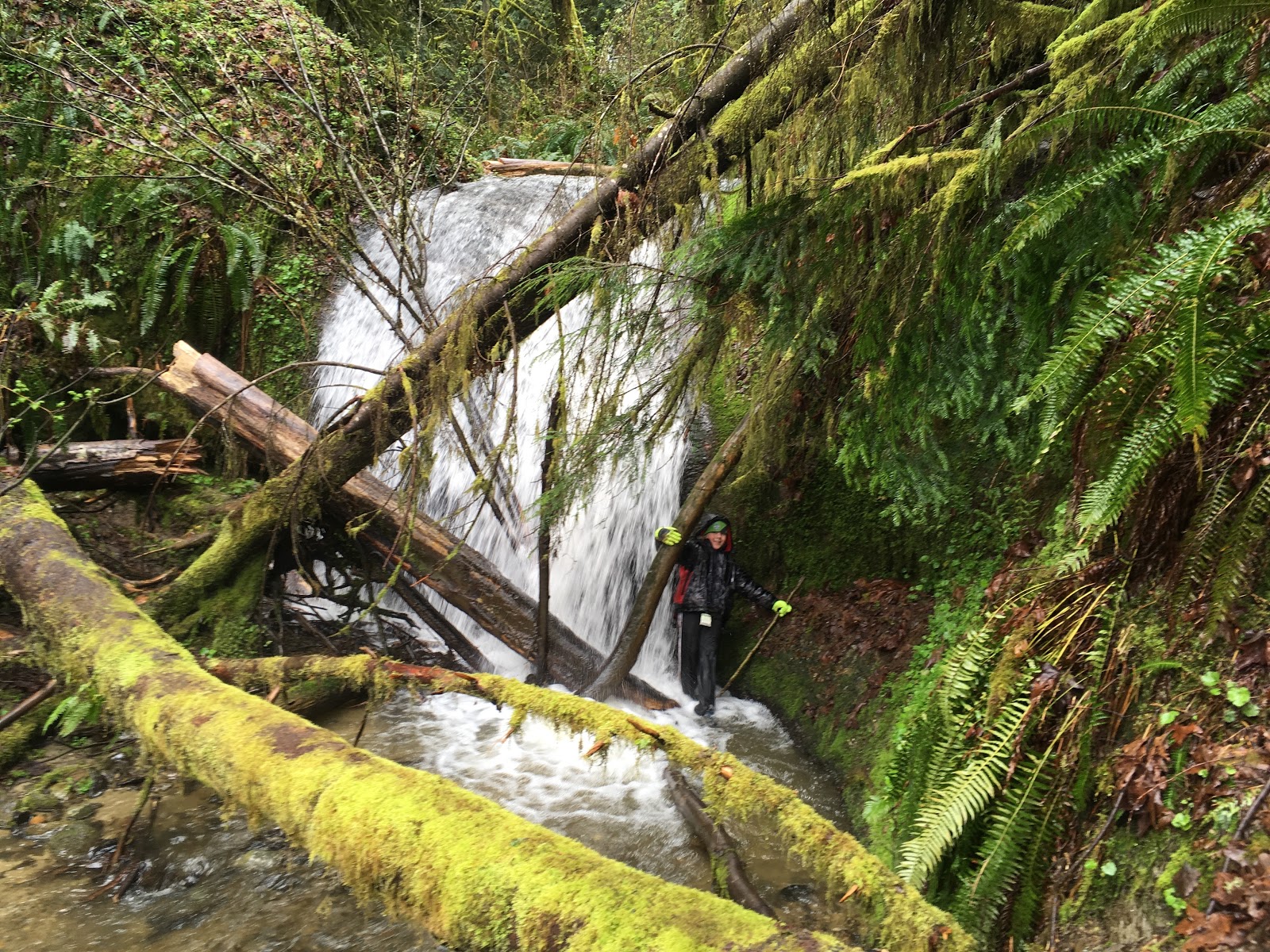
Hiking up the creek most of the boys were careful to protect their dry layers, while the rest carelessly overtopped their boots and drenched their under layers, losing their footing on the wet rocks. Standing a safe distance away from the 50-foot falls the views were breathtaking. The Explorers really enjoyed feeling the mist coming off the rocks and the sound of the crashing water that filled the arroyo.
One of the boys in the group brought a gold pan with him and finding a nice bank of sediment he taught the group to pan, they even found a few gold flecks! It was powerful to witness the boys connecting with a skill that has a deep history in the Pacific Northwest. Sensing we were at critical mass, as we were starting to get a little cold and in need of calories, we safely navigated our way back to the trail and climbed the switch backs until we found a lunch spot above the falls.
After lunch morale was low and the group looked cold. Playing a couple of rounds of hide to get us moving we circled back up to assess the plan we had come up with earlier. Through some excellent group decision-making facilitation the leader of the day helped the group amend their plan. The boys felt that sitting down to carve when it was pouring rain, with the group already cold, wouldn’t be a smart choice. They thought it was better to stay moving for the rest of the outing as a way to stay warm. The mentors made sure to point out to the group the wisdom in their decision and that it was okay to amend a plan based off of change in environmental conditions and what the group needed in the moment. They also reminded those who had not done as good of a job protecting their dry layers in the creek of the importance of thinking through decisions and acting preventatively.
Hiking along the vast wetland the boys searched for Pacific Chorus frogs and Salamanders, but the day proved to be a little too chilly for these cold-blooded amphibians to be out and about. After some exploration the boys started to again present the lethargic sort of ‘kicking around’ behavior that happens when morale is low and the rainy day starts to get to you. At this point the mentors knew they needed to intervene with a game. After playing a few rounds of Where My Egg? the group's spirit started to rise and they began to warm up.
Keeping on the move we made our way down to the logging road to harvest Rabbit Sticks. What is a Rabbit Stick you ask? A Rabbit Stick is a basic hunting tool used to stun birds and small mammals like rabbit and squirrels. In the context of Explorers Club we use them to hit target such as cans we find in the woods and stick targets we set-up.
Once each boy had a Vine Maple Rabbit Stick that fit well in their hands and was relatively easy to throw we went over our safety rules. Don’t throw when anyone is in front of you, have a clear line of slight for the entire distance you are throwing, be out in the open such as a field or logging road, and only use it for practice; because the Short-tailed Weasels are not prepared to properly harvest a small mammal or bird as well as not ready to make the decision of whether or not they would want to.
Setting up a small Rabbit Stick range we practiced our aim until it was time to circle up for a closing meeting and a round of thanks.
This outing was challenging for the group and they persevered. Some powers for the mentors from this outing was the boys ability to safely explore by the waterfall, the ability for games and activities to redirect us and change our attitudes, and for the heightened level of group decision-making that these Explorers showed. Checking in on our three group commitments before heading out the boys felt that they did a great job encouraging the hearts of their fellow explorers and being present, but needed to work a little bit on not wasting anyone’s time by being more focused in our circles.
The mentors reminded the group of their need to be responsible with Rabbit Sticks the same as we expect them to be responsible with their knives, using them as tools not weapons.

For more pictures please visit the Short-tailed Weasels’ photo album from the outing.

Thursday, March 1, 2018

Short-Tailed Weasels find Fatwood in the Snow at the Yew Street Woods


The Short-tailed Weasels arrived at the Yew Street Woods and immediately started sliding down the top of the water retention dome on a discarded piece of a broken sled. Snowmen were being built and snowballs were flying, which signaled to mentors to circle up for our opening meeting. Reining in the boys’ excitement and silly energy for the snowy exploration ahead, the mentors debriefed our last outing where the STW had struggled to show the necessary focus to prep the wood for a fire before the parents arrived to our potluck and continuously talked over the mentors and derailed the group process.
Setting the intention to improve upon our circle time, general focus, and group decision-making the mentors laid out three rules to help support the group. First to encourage the heart by supporting other group members, being genuine and caring towards one another, helping peers when needed, and keeping each other’s goals in mind. Second, don’t waste anyone’s time (including your own) by taking advantage of what is offered during the outing and listening when needed. Lastly to be here now, which is an Explorers Club motto that demands staying present and mindful during outings and group focused work.
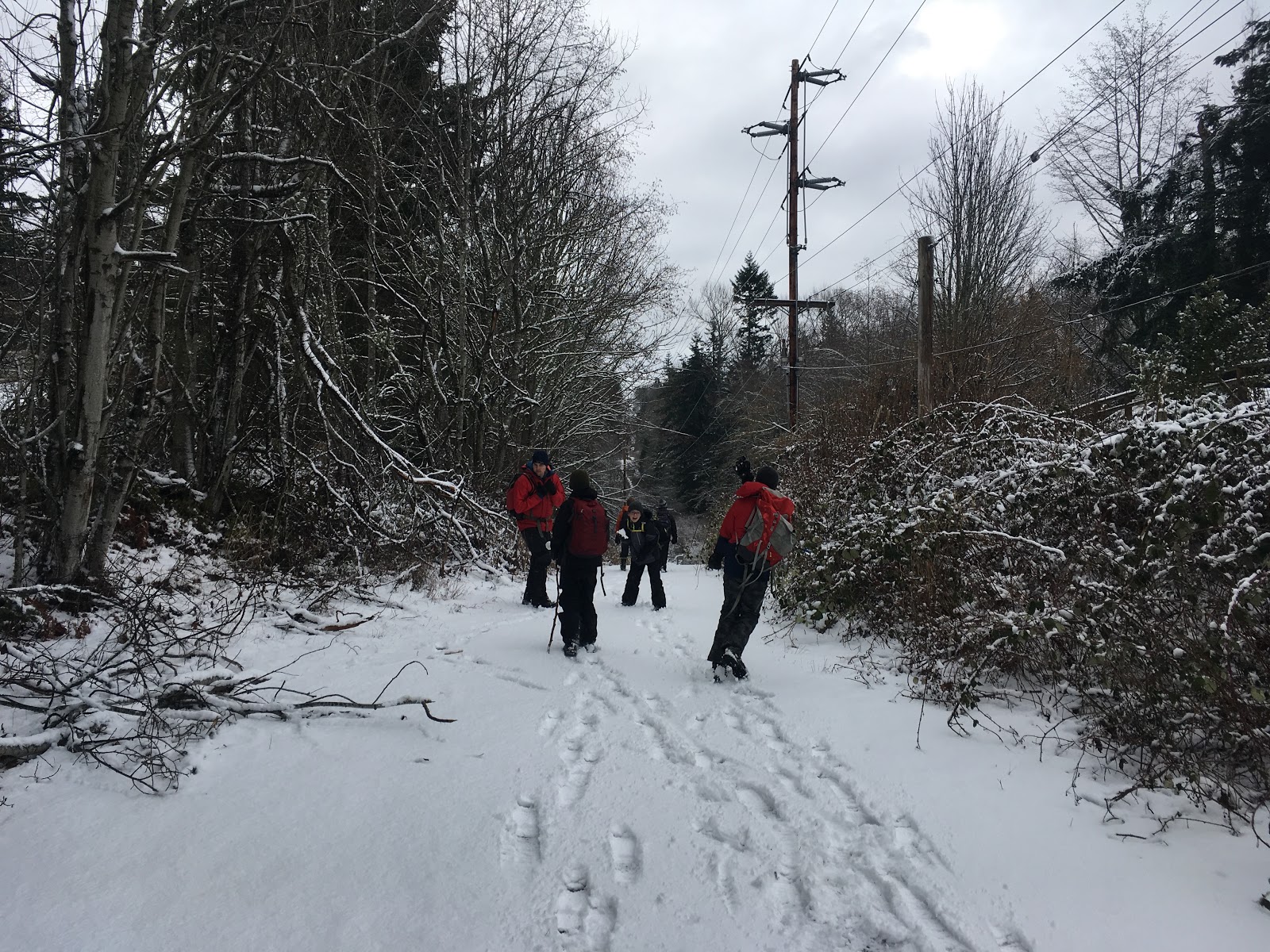
With our three rules in place and agreed upon we headed out and quickly connected with the power line trail. The snow blanketed the forest and highlighted its shapes and contours. The boys pointed out a few dog tracks alongside side the trail and commented on how the snow allowed them to see everything that was moving through the forest. It was truly a beautiful day.
For many of the Short-tailed Weasels the Yew Street Woods are quite literately their own backyard and their knowledge of this landscape and comfort in it shows. As mentors we aim to connect the Explorers with the wild spaces all around their homes in the hopes that they will recognize the value and complexity of even the most “urban” feeling natural spaces and develop a relationship with those places that promotes curiosity, creativity, investigation, agency, and stewardship. Adam and I believe that the Yew Streets Woods holds all of the qualities for these boys and it is powerful to witness.
Turning off the power line trail the boys navigated to the area that they had built shelters in the fall. They were surprised to find the shelters had collapsed. They ventured a guess that it was the weight of the snow that that toppled them, but also thought it could have been from the storms and wind throughout the winter. Earth skills like shelter building not only promote persistence and problem solving, they also help our Explorers recognize the seasonal changes that takes place within the forest.
Only an hour into our Exploration and the temperature had started to warm up and snow had begun to fall from the trees, making a glorious symphony of dripping and whumping sounds throughout the woods. Feeling the need for some calories the boys circled up under a Western Red Cedar and made a plan for the rest of their day.  Our Leader of the Day facilitated an excellent group decision-making process using the Four C’s: circle, collaborate, compromise, and consensus. The boys decided that they wanted to prioritize having free exploration time and an organized snowball fight. The mentors amended their plan adding the skill focus of looking for fatwood fire starters to carve and add to their Earth skills kits.
Locating a logged Douglas Fir stump that was starting to crumbled and deteriorate, the mentors asked the group to pull apart a section of it.  Digging away at it the boys started to notice two very distinct sections of the stump. The first part of the stump crumbled easily in their hands and broke into square-like sections.  This was due to a process called cubical butt rot, which the boys thought was hilarious and was caused by fungus mycelium. The second part of the stump was rock hard and stood vertical in thin knife-like sections.
The mentors explained that this was due to the tree’s response to being cut down. Trees do not die right away after being cut, but respond to being felled as a massive injury, sending loads of pitch from their roots to seal off the top of the stump in an attempt to ward off infection. Try as they might, the tree will eventually die and decomposition leaves sections of stump heavily impregnated with resin. After the cubical butt rot takes it toll on the dead stump it exposes vertical sections of fatwood or pitch impregnated grains in the woods that can be carved into shavings.
This resin-impregnated fatwood contains terpene, the main component of turpentine. It is incredibly flammable and takes flame effortlessly that hardly ever lets up. Because of this, fatwood shavings can be lit with a spark, even when wet, producing a flame that resists the wind and burns much hotter than regular shavings.
After our lesson the boys needed some decompression time and wandering out into the logging clear cuts, exploring what natural history wonders excited them in the moment. Searching out a premium stump we harvested a large chunk of fatwood and got to work processing it. Most of our group was really engaged in the skill and everyone walked away with an emergency fire starter stick.
A few of the boys carved some fatwood shavings off their fire starter sticks and got a tinder bundle together from some jute cordage. Using the mentor’s striker and ferrocerium rod the boys worked persistently to ignite the bundle. The flame they produced burned hot and bright! Nice work Short-tailed Weasels!
The group ended our day with a modified game of Spider’s Web that involved throwing snowballs. Although mentors have often seen snowball fights end in escalation and frustration (and they don’t quite fit our motto and culture of using tools not weapons) they are essential in any snow experience and seemingly satisfy a deeply primordial need for these boys that the mentors could not deny the group.  
The group played with honor by respecting each other and they tried their best not to make any “head shots”. Lively and bonded together the group circled up to give thanks and share apples. What a pleasure it was to share this snowy day with the Short-tailed Weasels. Before heading back to meet the parents the mentors pointed out how the group had held to the commitment of encouraging the heart, not wasting anyone’s time, and being here now and the positive effect it had on our outing.
Our mentors will continue to hold the group to these straightforward commitments in the outings to come and will continue to walk alongside them in support and encouragement as they grow together experientially as individuals and a group.

For more pictures from our outing please visit the Short-tailed Weasels’ photo album from the day.

Tuesday, December 12, 2017

The Short-Tailed Weasels Explore Group Dynamics and Skills at Stewart Mountain


The Short-tailed Weasels arrived at Stewart Mountain to find the Cave Dwellers group already there. Looking around a few of the STW’s recognized some members of the other group from outside of Explorers Club. After playing a fun ‘get to know you’ game the mentors talked about their plans for each of the groups’ outing. A few of the boys recognized that both groups would be working on similar skills during the day and asked about running a joint outing together.
Nominating a Leader of the Day to help facilitate the discussion the boys quickly realized that there were strong opinions on both sides and the decision was going to be a difficult one. The process was made more challenging by some members of the Short-tailed Weasels who had become overwhelmed and bored and as a result derailed our discussion by either drawing attention to themselves or talking over those who were trying to actively pursue collaboration and consensus.
After a solid fifteen minutes of discussion the group decided that even though they were working on the same skills and were only a year apart in age, it was better that they played a game a of Spider’s Web together and then went their separate ways. It was disappointing for the mentors to watch the boys come close to inclusion, knowledge sharing, and togetherness, but in the end for them to feel like their groups were in different places. However, one of the joys of Explorers Club is that we learn experientially over many outings and it was our role as mentors to hold to their decision.
Brian let out a crow call after setting up a game course in a dense grove of second growth Western Hemlock and Cedar and the boys disappeared in the ferns.
The game lasted for about forty-five minutes and provided just the right amount of challenge and redirection. The two groups followed the rules with honor and got caught up in the spirit of play. Calling the game at our allotted time we circled back up to debrief.
The mentors highlighted how the power of play had brought us together. To further reinforce this concept a mentor shared a story about the Northern Ireland Conflict where Nationalists (mainly self-identified as Roman Catholic) and Unionists (mainly self-identified as British or Protestant) waged guerrilla warfare against one another over differences in whether Northern Ireland should belong to Ireland or England for nearly thirty years. 3,500 people were killed in the conflict and many neighborhoods and families were left with deep scars and hatred for one another.
An Outdoor Professional from the region started a surfing program for children from both sides of the conflict. Through a medium of play and adventure they created strong friendships and goodwill amongst the younger generations. The boys seemed to internalize this mentoring message and the STW waved goodbye to the CD as they circled up to make a plan for the rest of their day.
Turning to the Leader of the Day the group needed to decide how to fit in eating their lunch, finding a location to work on some knife sharpening and tarp shelter making skills, and also provided a container for some free exploration. Once again some of the Explorers started to derail the group using sarcasm and humor about the process along with interjecting other subjects that were off-topic and disruptive. The boys were looking for the mentors’ edge and had found it. Getting triangular with the group the mentors asked the boys why they thought their behavior was appropriate and if they really wanted to participate. The mentors also let the group know that we purposefully choose to engage in this work bringing intention and care to each outing, and we expect the boys to be present and engaged.
With their plan in place the boys headed down to Lake Whatcom to eat their lunch and then hiked up the Chanterelle Trail in search of a quiet place off-trail to engage in skills. Taking out a knife sharpening kit and the resources to make a tarp shelter the STW’s energy calmed down and the mentors were able to get strong focus from the group. A portion of the group worked on tarp shelters learning to: carve tent pegs, how to tie a tarp knot, the proper height to raise the shelter to, and how to get a clean smooth shelter surface to fend off rain using 45 degree angles and taught lines attached to the tarp’s grommets.
Adam provided some hot chocolate on his jet boil stove while he worked with a few of the boys on knife sharpening. The group harmoniously worked away following their interests. Circling up for a closing meeting we debriefed the second half of the day highlighting the mentors ability to pass on knowledge, skills, and give more autonomy and responsibility when the groups demonstrates that they are ready for it. Sharing our thanks and some apples the group suffered more interruption and again needed to be reminded of our behavioral expectations for our meeting time.
The Short-tailed Weasels’ group work needs improvement and one hundred percent focus and engagement from its members in order to thrive. Fortunately mentors and Explorers alike are given the gift of time in this program and the STW will have the chance to try again after our holiday break. Adam and I are thankful to work with your sons and for your commitment and support for the program. We see opportunity in the group’s challenging dynamics and look forward to tailoring our next few outings to help facilitate their capacity for leadership and engagement.


For more pictures from our outing please visit the Short-Tailed Weasels’ photo album from the day.

Thursday, October 5, 2017

The Short-Tailed Weasels Collaborate Beside Caves on the Rock Trail


The Short Tailed Weasels arrived in a convoy for the first outing of the fall season. We gathered together for opening circle and after meeting new group members and going over our plan for the day we headed down the Rock Trail. Our focus for the day would be shelter building, however in the end we would learn our true lessons would be learned on another topic. 

Checking the map for information to help our outing
Heading down the trail the group was tasked with searching out “natural shelter” as in any emergency, finding a shelter that is already build for you is much quicker and easier than constructing one of your own. Further down the trail we found a series of caves that offered up plenty of natural shelter. One of the caves in the sandstone cliffs was even big enough to fit four Explorers!

Hiking beside the sandstone cliffs

Clambering into caves!

Seeing how many Explorers can fit in the cave
 Transitioning to the second half of our outing we circled up to plan what to do. We would need to focus on shelter building, however afterwards we had the option of either playing Spider’s Web or trying to hike down to Lost Lake. As the group tried to deliberate on what to do, we revisited the “four C’s of decision making”; circle, collaborate, compromise, consensus. First and foremost we needed to circle up and focus ourselves on communicating with one another. Next we took time for each person to share what they wanted to do. The upcoming step of compromising was where we faced our challenge for the day. 

Hanging out to eat lunch
With about half of the group wanting to play Spider’s Web and the other half wanting to go to Lizard Lake, we hit a sticking point in our decision making. After much deliberation and discussion the majority of the group began leaning towards Spider’s Web, however a couple group members were still not satisfied with the plan. Although most of the time outside of Explorers Club, decisions like this are made by a democratic vote resulting in a majority rules scenario. However, this often leaves a group polarized and at least a few members, if not half of the group, unhappy with the decision made. In order for a group to agree with a decision in its entirety, a consensus must be reached. This is not easy, and we asked a lot of the Short-Tailed Weasels to come to a consensus, but through determination and thoughtful compromise we finally arrived at a consensus. We would have a brief shelter building lesson followed by a game of Spider’s web and a strong intention of returning to the Rock Trail in the spring time to hike down to Lizard Lake. 

Transitioning to learning how to construct a model debris hut
Although the process of reaching a consensus is often painstaking for both Explorer and Mentor alike, the resulting group morale and lessons learned in communication, leadership, and creative thinking to arrive at a compromise were well worth the lengthy time in circle. Not only did this group get a chance to play games and practice their shelter building, but they took a big step forward in their ability to function as a whole and arrive at decisions that everyone can agree upon.

Proud shelter builders. Next we will see how they do constructing full size shelters!
Check out the rest of the photos form our outing here!