Showing posts with label spring. Show all posts

Wednesday, April 25, 2018

Short-tailed Weasels Weather the Storm at Lookout Mountain


The Short-tailed Weasels met at Lookout Mountain Forest Preserve for a day of exploration and working on carving skills. They circled up in the parking lot as the rain poured down and saturating everything, including our rain layers. After revisiting our three group commitments we made a plan for the day: hike to the waterfall and spend some time exploring for amphibians, then connect with the main logging road to harvest some of the Vine Maple from the brush cutting that had been done to maintain the width of the road. We would be able to make some excellent tend pegs and digging sticks from the strong and dense Vine Maple hardwood.
Looking around the circle the boys were clearly ready to retreat under the shelter of the forest canopy. Hiking along the signs of spring were all around, a full spectrum of the color green engulfed the forest. Salmonberry flowers were in peak bloom and the Cottonwood leaves were beginning to sprout, sending their sweet aroma into the air. As a mentoring strategy we try to highlight these seasonal changes for the boys so they can begin to recognize the signs of changing seasons. Drawing connections to exploring in the pouring rain and its ability to transform the forest has proven to lighten the Explorers hearts in the toughest of conditions. Two Explorer Club mottos come to mind in these moments attitude of gratitude and all things are connected.
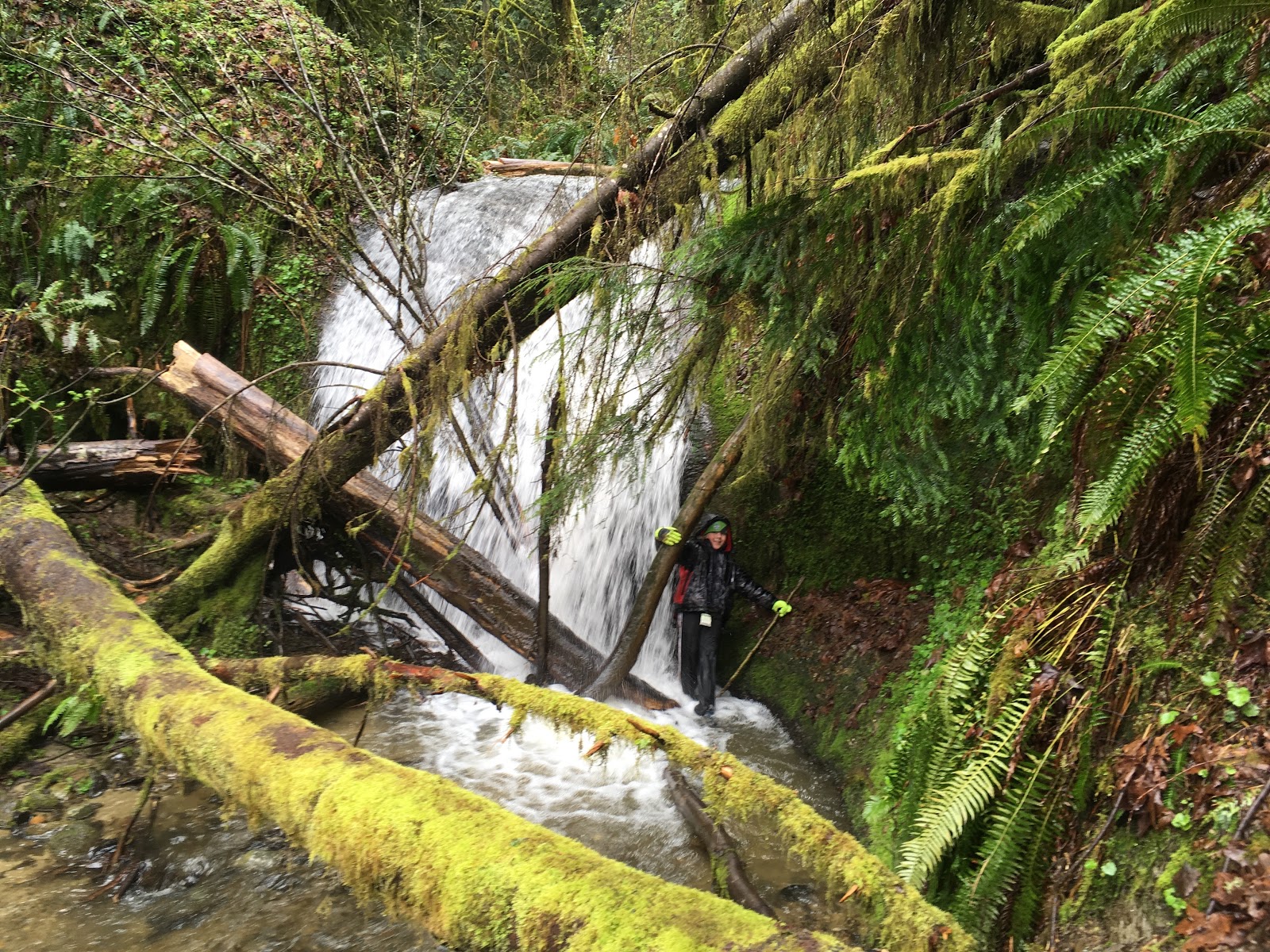
Hiking up to the lookout above the falls the boys were anxious to explore the creek below it. One of the mentors scouted a deer trail and came back to the group with some beta. Lookout Mountain Falls runs through a very steep arroyo with easily impacted valley walls. With fourteen pairs of feet scrapping and sliding down to the creek we would be sure to cause some erosion and negative impact to the creeks ecosystem. Together we talked about some of the organisms and plants that might be affected by this impact. The mentor went on to explain that a path down to the falls next to the lookout had been closed for this very reason and that Whatcom County parks was currently trying to mitigate and manage this impact.
After roughly half an hour of scouting we found a low incline way down to the creek and were able to navigate it while causing minimal erosion. Along the way down we came across special flower called Trillium. The boys were told to watch their feet so they did not step on any because a trillium can take up to ten years to produce its first flower and seed. The flowers are common in the forest, but important in the ecosystem for pollinators and ants that eat off the seeds before discarding them and dispersing them in the process.
Hiking up the creek most of the boys were careful to protect their dry layers, while the rest carelessly overtopped their boots and drenched their under layers, losing their footing on the wet rocks. Standing a safe distance away from the 50-foot falls the views were breathtaking. The Explorers really enjoyed feeling the mist coming off the rocks and the sound of the crashing water that filled the arroyo.
One of the boys in the group brought a gold pan with him and finding a nice bank of sediment he taught the group to pan, they even found a few gold flecks! It was powerful to witness the boys connecting with a skill that has a deep history in the Pacific Northwest. Sensing we were at critical mass, as we were starting to get a little cold and in need of calories, we safely navigated our way back to the trail and climbed the switch backs until we found a lunch spot above the falls.
After lunch morale was low and the group looked cold. Playing a couple of rounds of hide to get us moving we circled back up to assess the plan we had come up with earlier. Through some excellent group decision-making facilitation the leader of the day helped the group amend their plan. The boys felt that sitting down to carve when it was pouring rain, with the group already cold, wouldn’t be a smart choice. They thought it was better to stay moving for the rest of the outing as a way to stay warm. The mentors made sure to point out to the group the wisdom in their decision and that it was okay to amend a plan based off of change in environmental conditions and what the group needed in the moment. They also reminded those who had not done as good of a job protecting their dry layers in the creek of the importance of thinking through decisions and acting preventatively.
Hiking along the vast wetland the boys searched for Pacific Chorus frogs and Salamanders, but the day proved to be a little too chilly for these cold-blooded amphibians to be out and about. After some exploration the boys started to again present the lethargic sort of ‘kicking around’ behavior that happens when morale is low and the rainy day starts to get to you. At this point the mentors knew they needed to intervene with a game. After playing a few rounds of Where My Egg? the group's spirit started to rise and they began to warm up.
Keeping on the move we made our way down to the logging road to harvest Rabbit Sticks. What is a Rabbit Stick you ask? A Rabbit Stick is a basic hunting tool used to stun birds and small mammals like rabbit and squirrels. In the context of Explorers Club we use them to hit target such as cans we find in the woods and stick targets we set-up.
Once each boy had a Vine Maple Rabbit Stick that fit well in their hands and was relatively easy to throw we went over our safety rules. Don’t throw when anyone is in front of you, have a clear line of slight for the entire distance you are throwing, be out in the open such as a field or logging road, and only use it for practice; because the Short-tailed Weasels are not prepared to properly harvest a small mammal or bird as well as not ready to make the decision of whether or not they would want to.
Setting up a small Rabbit Stick range we practiced our aim until it was time to circle up for a closing meeting and a round of thanks.
This outing was challenging for the group and they persevered. Some powers for the mentors from this outing was the boys ability to safely explore by the waterfall, the ability for games and activities to redirect us and change our attitudes, and for the heightened level of group decision-making that these Explorers showed. Checking in on our three group commitments before heading out the boys felt that they did a great job encouraging the hearts of their fellow explorers and being present, but needed to work a little bit on not wasting anyone’s time by being more focused in our circles.
The mentors reminded the group of their need to be responsible with Rabbit Sticks the same as we expect them to be responsible with their knives, using them as tools not weapons.

For more pictures please visit the Short-tailed Weasels’ photo album from the outing.

Thursday, May 26, 2016

Short-Tailed Weasels Exploration at North Lake Whatcom Trailhead

The Short-Tailed Weasels gathered at the parking lot of North Lake Whatcom Trailhead for their last exploration of the spring season. Once they assembled, the group headed down the trail in searching of a spot for an opening meeting. Hiking along the forest was wet and saturated. The shades of gray in the low hanging cloud ceiling and slight southerly breeze chilled the air and refreshed the group. The climate reminded us of the weather much more typical to our Pacific Northwest spring season. It was powerful to witness the Explorers mindset and relationship with the rain shifting in this way. In Explorers Club we go out often in the rain and cold. Our aim is for the boys to begin to see this weather as a gift more than an advisory.
Finding a clearing next to the trail the group circled up as the mentors passed out jobs for the day. With a little encouragement from the swarming mosquitos the boys were able to recall each of the Explorers Club jobs and delegate a few that were deemed less desirable. The group was anxious to move, but the mentors held the circle explaining there were a few more important topics to address. The boys stretched their edge and worked hard to make a plan for the day in spite of their discomfort. Our aim was to hike a mile down the trail in search of multi-tiered waterfall then follow the creek down to the shore of the lake for a sit spot. We would end our day leaving a good chunk of time for Spider’s Web.
With a plan in order and our minds oriented toward the landscape we headed out in search of the falls. On the way the boys explored their skill for the season the Art of Harvest, taking moments along the trail to investigate the flowers and fruits of spring. Together we looked at Stinging Nettle stalks, Indian Plum fruits, Western Hemlock tips, and the elegant flowers of Red Columbine, Aquilegia Formosa. The boys were also introduced to a very helpful plant Herb Robert (more commonly known to the Explorers as Stink Bob) whose fresh leaves can be rubbed onto the skin to repel mosquitos.
After a solid effort the boys arrived at the base of the waterfall. Looking up the pools overflowed and cascaded down smooth Sandstone faces. Climbing over a logjam the group tucked into the woods and sat down for some lunch. Before we explored the falls any closer the mentors wanted to layout some ground rules. The Mentors talked with the group about two issues: making sure we stayed off the steep trail above us, and watching our own impact of erosion on the creek. The mentors stressed the connection of clear, clean, and cool water and its relationship with healthy habitat for the amphibians, macro invertebrates, and fish. Deepening this connection the mentors explained that this creek also poured directly into our own water source Lake Whatcom.
With that the group explored freely up the first half of the falls getting close enough to feel the spray of the water off the rocks and practicing their balance on logs that bridged the creek. It was at this moment that one of the Explorers got on the side of a hill and he did not feel he could go up or down. In this case the Explorer perceived that the risk was great, but the physical risk was quite low. One of the mentors worked with the Explorer for over half an hour helping him to overcome his fear and navigate the hurdle. This was an empowering moment for both the mentor and mentee. Our longer outing format and deliberate mentoring style provides the time and space for the Explorers to overcome their hurdles and find the power in their challenges.
Simultaneously the rest of the boys were hopping down the creek checking out tiny fish and Water Striders on their way to the lake. Rallying the group the mentors sent the boys out on a sit spot near the lakeshore. Getting quiet the boys relaxed back against the trees and listened to the wind move and waves lapping against the shore. As we sat an American Dipper frolicked on the streams edge feasting on bugs. This was yet another reminder that species in the forest were rejoicing for the rainfall.
The Short-Tailed Weasels came back from their sit spot to find three concentric circles drawn into the forest floor. Earlier a few boys had asked why it was difficult for the Explorer to navigate the seemly easy obstacle of getting down off the hillside. Asking the boys to stand outside the widest circle, the mentors explained that each circle represented a comfort level: the first being completely comfortable, the next being semi-comfortable but still within their growth zone, and the third being completely in the panic zone. The group was to place themselves inside the appropriate circle when asked their comfort level in different circumstances.
As the boys ebbed and flowed between the circles they came to realize that everyone was different in levels of comfort in each scenario. Together they came to realize the important lesson that their peers all have individual powers and challenges and it is the job of the group to help each other work through them.
Feeling the push of the clock we hiked back near the parking lot, stopping at a dense grove of Cedar and Sword Ferns for a round of Spider’s Web. The first round was over in about five minutes with the Spider wining after decimating the fly population. Gathering back up, the group used circular leadership to modify the game to increase the level of challenge for the spider. The next game lasted quite a bit longer and had to be called halfway through because we needed to have a closing circle.
Bringing our focus together the group passed around apples and shared some genuine thanks as well as one thing they heard and how they felt on their sit spot. 
Our outing had come full circle as the mosquitos started to swarm us once again.
Before going our separate ways for the summer the mentors asked the group where they would like to go on their upcoming fall 2016 season. The boys mentioned wanting to begin their carving journey, which is definitely on the table, and wanting to visit Lake Padden, Clayton Beach, Arroyo Park, and return to North Lake Whatcom. 
Parents, thanks you for your strong support and commitment to the program. Our time spent building relationships with your sons throughout their first season in Explorers Club has been wonderful. Our mentors have begun to vision and dream for their years ahead in the program. We look forward to exploring with them in our summer programs and again this fall!


For more photos from the day please visit the Short-Tailed Weasels photo album from the day.

Wednesday, April 27, 2016

Short-Tailed Weasels Traverse the Sehome Arboretum

The Short-Tailed Weasels arrived at the lower Sehome Arboretum parking lot enthusiastic for their outing and reassured by the sunshine. The group waved goodbye to their parents and circled up under the shade of a few large Douglas Fir for an opening meeting.
The boys welcomed our guest, Lauren Prater. Lauren explained that she was a journalism student at Western Washington University who would be taking photos for an article in the independent student publication called Klipsun. Parents, we’ll be sure to forward the article when it releases in Klipsun’s second spring quarterly issue.
Once we were acquainted we spent some time talking about the outing that lied ahead. The mentors explained that the day was a much different style of outing than any the group had encountered before. We would be traversing from the bottom of the Arboretum to the top. Not only would the group need to pay attention to which way they were
headed, they would also need to keep close track of their belongings and peers. Together we worked on orienting ourselves to the four cardinal directions and passed out jobs for the day. With that we were off and within less than a minute we were joined up in circle again.
The topographic map provided on the south end of the Arboretum gave the boys three trail options, all of which led to the Lookout Tower and parking lot at the top. As is often the case in Explorers Club, coming to a junction in the trail means that it is time for the Tribal Elder to facilitate the group decision-making process.
Our mentors would like to commend the Short-Tailed Weasels on their ability to work together as a group and consider their peers’ feelings and opinions. What many Explorers Club groups come to find out about this traverse is that its abundance of trails makes for frequent route decisions, which often become the source of frustration. This was not the case for our group. Through collaboration and compromise these Explorers were able to pack in a full day and have a lot of fun on the way.
Hiking along the trail the group marveled at the abundance of new foliage and flowers that filled the forest. Together we investigated and learned about Vanilla Leaf, Sliver-Beaked Hazelnut, Oregon Grape, Red-Flowering Currant, and Indian plum just to name a few. Spring is the ideal time to learn about these plants because the identifiable characteristics of each species are prominent.
Coming to yet another junction in the trail we though it best to introduce Lauren to a classic Explorers Club game of Hide! Our mentors observed that over the course of one season these Explorers have grown significantly in their ability to sneak, stalk, and get quiet while playing Hide. Hiding amongst the underbrush not only gets the Explorers comfortable with be being dirty and wet, it also builds their awareness for flora and fauna around them by literately immersing them in it.
Veering slightly off trail the mentors showed the group a large Sandstone ridgeline that revealed a twenty foot cliff roughly 300 feet long. Using a deer trail the boys navigated safely down the cliff and spent a while bouldering at its base. It was a great time to revisit how to spot a partner while climbing and the safe way to look over a cliff’s edge.
Gathering back up at the top of the ridge the boys wanted to stay longer, but the mentors reminded them of the task at hand on our traverse. We made an agreement as a group that we needed to finish at least three-fourths of our traverse before we would sit down to play a game of Spider’s Web. The boys pressed on and Grasped the Nettle as they pushed up the hill. For some their struggle stemmed from the physical challenge of the traverse, and for others it was keeping their focus on the task at hand. The mentors reminded the group that we all had our own powers and challenges and that it was important to support each other.
Climbing the hill to the top of the Arboretum we waved goodbye to Lauren and thanked her for joining us for the day. Taking the trail to the top of the tunnel the boys found some sunny rocks and lunched while reveling in their accomplishment. As boys started to finish a fir cone war broke out and the mentors knew that it was time to refocus our energy. Turning the circle over to the Tribal Elder the boys worked through plan to fit in a game of Spider’s Web, have a Sit Spot, and venture to the top of the tower to soak up the views of Mt. Baker.
Heading over to one of the mentors favorite secluded valleys we set up a game of Spider’s Web, which proved to be quiet challenging for the boys due to the terrain. We played for about forty-five minutes and the flies ended up prevailing over the spider. Grouping back up the boys shared their battle scars with each other. The boy’s arms and legs were covered with Nettle stings and scrapes from downed logs. A few boys were in quite a bit of pain, but they worked through it by embracing their discomfort.
The mentors then sent the boys out on a sit spot, reminding them that it was just as important to spend some silent solo time getting to know the land as it was to play and explore in it. Settling in amongst the waist high Sword Ferns calls of Varied Thrush and Winter Wren rang out across the valley. One boy even mentioned hearing a Downy Woodpecker preforming his excavation against a tree trunk.
Crow Calling the group back in we headed up to the lookout tower and stood for a while starring at the Twin Sisters and Mt. Baker in all their glory. 
After we had our fill we found an open spot in the woods to hold our closing meeting. Sharing apples the boys gave thanks for the abundance of spring, for friends and family, for the ability to explore all day in a landscape right outside our backdoors, for the edible Big Leaf Maple blossoms, for the opportunity to be part of a peer group, and for Nettles and pokey logs which give so much to our forest and build our awareness.

For more pictures from the day, please visit the Short-Tailed Weasel’s 4/17/16 photos album.

Thursday, March 31, 2016

Short-Tailed Weasels explore & harvest above Lake Padden

Circling up for the Short-Tailed Weasels first outing of the new spring season, new faces were introduced, and jobs were divided with our focus maintained on getting out onto the trail. With the help of our Tribal Elder, the boys reached a consensus at our first trail junction, deciding to explore a new trail and following the lead of one of our explorers to take us to the perfect spot to play Spider’s Web. The way through to this magical area was not without its challenges. Bushwhacking down a steep hill pushed some of our explorers to their edges, and challenges the loamy soils ability to hold together the roots of sword ferns, Oregon grape, and salal. 
Finding a nice log to sit on, we enjoyed our snacks while waiting for our dispersed group to all gather together again. We discussed erosion and the impact we all have on our landscapes, and decided that we would go out a different way than we came to this spot, so as not to stress the slope’s soil further. Not that we were planning on leaving anytime soon! We’d found our perfect Spider’s Web spot, bounded on two sides by steep terrain, with a hill in between to create a series of hills and valleys, all covered in the camouflaging sword fern. We even discovered, while exploring this spot to try and discern where our boundaries should be, evidence of other Explorers Club activity in the area, in the form of a very well constructed debris shelter in one of the valleys!

After discussing our boundaries and reminding ourselves of the rules, the boys nominated their new mentor Conor to be the spider, a choice which would test the limits and stretch the edges of their camouflaging skills. For over an hour, the boys try many different tactics to camouflage their movements as they attempted to home in on the food source – a bandana hidden well up one of the valleys – and rescuing each other from the spiders web when their movements and rustlings were called out by the spider. Never losing focus or enthusiasm, the boys sportsmanship, skill and spirit finally paid off when our newest explorer succeeded at taking the food source around the back of the hill to the web, thus winning the game for the flies! Circling round to debrief the game, we discussed the boys different strategies and found opportunities to learn from our successes and mistakes.
Following a path Steve had scouted as we played spiders web, we rejoined the trail and began our journey back, as well as the journey into our skill focus for the season – harvesting. Here the Short-Tailed Weasels and mentors were challenged to hold the space for harvesting knowledge while energy levels ranged from focused to hyperactive. With the help of our Knowledge Keeper, we learned how to identify stinging nettle – saw toothed leaves, square stems, leaves opposite each other, short stinging hairs on stock and leaf – and that one can harvest it without stinging themselves, by picking the leaf from the top where there are few if any hairs, and rolling the bottom of the leaf against itself to remove the stingers. One important element of harvesting is how to not take too many: For every one we take, we leave one alone for other animals to eat, one alone to make seed and regenerate the plant, and one alone for the intrinsic value that plant has to exist on its own.
After harvesting a pot full of nettle leaves, we continued on the trail back in search of a good spot for our closing meeting. Before we found our spot however, we found another edible plant, the licorice root fern. Found growing through the moss of Big Leaf maple trees, one can feel for the end the fern’s roots, and harvest a modest amount. We’re careful not to harvest the middle of a root, as this will kill the plant below our harvest. The root tastes very much like licorice, and after sampling some on the spot, we harvest enough to add to the pot of nettles we’re intent on brewing into tea.
We ended our day with a sit spot overlooking the dog park – not the best choice of location perhaps, but a perfect way to bring our energy focus back to our harvest being boiled into tea, and reflection on gratitude for what nature provides. After our tea of nettle, licorice root fern, peppermint tea, cedar fronds and fresh water had steeped, we gathered ourselves back from our sit spots for our closing circle. Drinking tea and eating apples, we have thanks for nature’s bounty, and to consecrate the end of the beginning of the Short-Tailed Weasels spring season.